


Women Self Medicating to be Horny: Is This a Good Thing?
Description
Dive into a fascinating and provocative discussion about the growing trend of women using pharmaceuticals and hormones to boost their sex drive. Hosts Simone and Malcolm Collins explore the cultural, medical, and social implications of drugs like Addyi (the so-called “female Viagra”) and testosterone therapy, referencing recent New York Times articles and real-life stories.
The conversation covers:
* The science behind female libido and the diagnosis of hypoactive sexual desire disorder (HSDD)
* The rise of medications and hormone treatments aimed at increasing women’s sexual desire
* The cultural phenomenon of women openly discussing and experimenting with these treatments
* The impact on relationships, marriage, and family life
* The debate over whether society should encourage or question the pursuit of higher female sex drive
* The generational divide in attitudes toward sex and intimacy
* The risks, side effects, and ethical questions surrounding medicating for desire
Whether you’re curious about the latest trends in sexual health, interested in the intersection of medicine and culture, or just want to hear a candid, humorous take on a taboo topic, this episode is for you.
If you enjoy the discussion, don’t forget to like, comment, and subscribe for more thought-provoking conversations! Also, as this was a Simone-outlined episode, here are our show notes!
Episode Outline - The Women Drugging Themselves to Be Horny
Women Trying to Medicate Sex Drives / hypoactive sexual desire disorder
The Gist
* As much as we talk about everyone becoming increasingly sexless, there is a subset of women who are ALL ABOUT sex, and they’ll even go to great lengths to stoke sex drives when they have none
* Testosterone
* Flibanserin
* Dropping and changing birth control and other medications
* The NY Times has written various articles covering elements of this subset of women
* I’ll walk you through the issue
* And in the end, I want your take, and I want listener’s takes, on whether the pursuit of a higher female sex drive is important, neutral, or detrimental
Series of NY Times Stories on Women Pushing for Sex
Viagra for Women
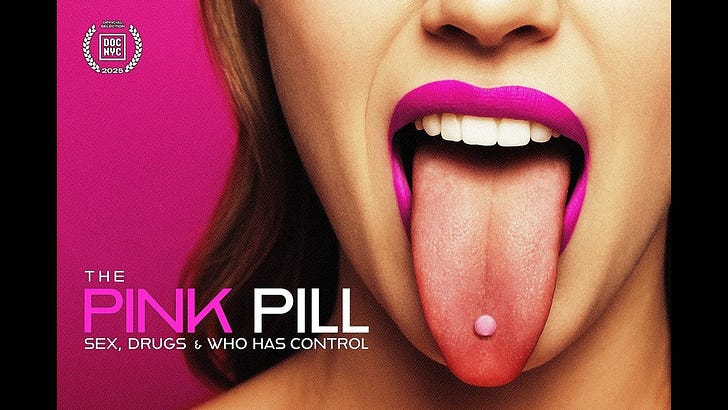
The “gateway” article to this issue for me was about basically viagra for women—a medication called Filbanserin branded as Addyi that’s marketed as “the little pink pill” by a woman named Cindy Eckert who herself is famous for integrating pink into every aspect of her style.
Here’s a 2025 documentary premiering about it:
Cindy has been trying, through her company Sprout Pharmaceuticals, to promote Addyi for a decade
* Her work was recently covered by the NY Times:
* A Pill for Women’s Libido Meets a Cultural Moment
* A decade ago, Cindy Eckert struggled to convince skeptics about a drug for premenopausal women. Lately, her business is booming.
Why Do Women Need Viagra?
Flibanserin is meant to treat Hypoactive Sexual Desire Disorder (aka HSDD), which is a measurable condition
Women with HSDD have different brain activity
https://pubmed.ncbi.nlm.nih.gov/18976696
* This functional MRI (fMRI) study compared brain activation and sexual response between:
* 20 women without sexual dysfunction (NHSD)
* 16 women diagnosed with HSDD
Participants were exposed to erotic, sports, and relaxing video segments. Researchers measured subjective sexual arousal, physiological arousal using a vaginal photoplethysmograph (VPP), and brain activation at three sessions.
The differences suggest that women with HSDD may have altered encoding or retrieval of arousing stimuli and possibly devote more cognitive attention to monitoring/evaluating their responses, which might interfere with normal sexual response. This is indicated by increased activation in specific brain areas linked to attention and evaluation.
So what does flibanserin do?
* Slightly increases sexual desire and activity
* Slightly lowers distress
* Causes drowsiness and lowers blood pressure, especially when combined with alcohol
* WHY NOT JUST DRINK???
The weird thing about this drug is that it’s not really effective.
The FDA rejected Sprout Pharmaceutical’s application for approval for the drug (again, because WHY NOT JUST GET DRUNK). From the NY Times article: “To be turned down twice by the F.D.A. is typically a death sentence for new drugs. But for flibanserin, the decision had the opposite effect: It galvanized a movement of women who believed the rejection reeked of sexism.”
The FDA eventually approved Addyi after a heavy resistance campaign, financed by Sprout Pharmaceuticals: “The F.D.A. approved flibanserin in 2015, writing later in the New England Journal of Medicine that while “the average treatment effects were small” (about 10 percent higher than placebo) “efficacy had been established.””
So what makes Addyi interesting is the discourse around it—the fact that prominent actress and influencers like Gwenyth Paltrow are writing and talking about it—and not that it’s particularly effective.
What’s interesting is that women care.
Women Taking Testosterone
Let’s move on to medical intervention that is more effective at increasing sex drive: Testosterone
The NY Times also covered this with:
* ‘I’m on Fire’: Testosterone Is Giving Women Back Their Sex Drive — and Then Some
* There is no F.D.A.-approved testosterone product for women. Insurance won’t cover it. Many doctors won’t prescribe it. It’s become a cultural phenomenon
* https://archive.is/KcwIA#selection-473.0-477.153
Great opening: “Spend enough time speaking to women who are taking testosterone — specifically, in very high doses — and you start to notice that they sound messianic. They’re often talking fast and intensely; they’re amped up; they’re describing what they clearly consider a miracle drug; and they have no intention of lowering their dose, despite the unknown risks or some problems with facial hair. After all, how can they worry about facial hair when they feel so alive? It’s nothing they can’t take care of with a quick waxing, which they now have the energy to do at the end of the day — right after they prepare a high-protein dinner for their family and before they put the finishing touches on their spreadsheets, close their laptops and light a few mood candles for the sex that they know will be great, maybe even better than the sex they had last night, even though they’re a day older.”
The article is about how Testosterone therapy has become a cultural phenomenon among women seeking to boost their sex drive and overall energy, despite there being no F.D.A.-approved testosterone products for women in the U.S., and significant barriers such as lack of insurance coverage and reluctance among many doctors to prescribe the hormone.
The article focuses on the lack of regulatory and medical support for female testosterone supplementation, despite the fact that it drops with age and can diminish sexual desire and motivation in women, which has pushed women toward expensive, non-traditional supplementation.
To be fair, as the article points out: “For men experiencing the effects of low testosterone — low libido, low energy, loss of muscle mass — the F.D.A. has approved more than 30 products since the 1950s; and yet, to this day, there is no F.D.A.-approved testosterone cream, patch, pill or shot for women, even though their testosterone levels fall far more precipitously than men’s as they age.”
Women who take testosterone — often at higher doses than medically recommended —
* report dramatic increases in energy, libido, and marital intimacy. Some describe near-miraculous transformations in their relationships and personal drive. However, these gains come with risks:
* Side effects can include facial hair, acne, hair loss, deepening of the voice, and, in some cases, enlarged clitoris or persistent irritation and anger.
It’s clear that testosterone does more to help sex drive than Addyi. From the article: “Both Medina and Lin are taking an amount of testosterone that’s brought their levels higher than what women produce naturally at any point in their lifetimes. The way they and many women on these high doses talk about their relationships sometimes has the ring of romantasy: fantastic tales of sexual rejuvenation and newfound intimacy. One woman in her 50s told me that after years of revulsion at so much as the thought of her husband’s breath, she now looked forward to having sex with him almost every night; even in the middle of sex, she said, she was thinking about the next time they could have sex. Another woman told me she’d had more orgasms in the past two years on testosterone than in the entirety of her previous life; a third said that after years of “wanting to rip someone’s face off” if her husband so much as touched her, she now actively pursued sex with him — if anything, she now worried, she wanted it more often than he did.”
It’s also clear that women’s advocacy of testosterone is going somewhat mainstream: “This season on “The Real Housewives of Orange County,” three of the show’s stars described their testosterone regimens: Gretchen Rossi was shown baring her bottom as her doctor implanted beneath her skin a tiny but powerful pellet packed with crystalline testosterone that would be released over the course of about four months. She commented afterward that she had recently reduced her levels. “I had to take mine down because I was humping everything






















 United States
